 This book is EXCELLENT! Bill Bryson's book is very informative, very easy to read, and surprisingly, very funny! I chortled at many of his narratives about eccentric scientists. The human stories in the book made the story of science lively and engaging, something which a lesser writer would have killed or rendered dry as dust (think school science text books).
Highly recommended!
This book is EXCELLENT! Bill Bryson's book is very informative, very easy to read, and surprisingly, very funny! I chortled at many of his narratives about eccentric scientists. The human stories in the book made the story of science lively and engaging, something which a lesser writer would have killed or rendered dry as dust (think school science text books).
Highly recommended!
Showing posts with label science. Show all posts
Showing posts with label science. Show all posts
Thursday, 20 August 2009
Bill Bryson's - A Short History of Nearly Everything
I have just finished reading Bill Bryson's "A Short History of Nearly Everything".
 This book is EXCELLENT! Bill Bryson's book is very informative, very easy to read, and surprisingly, very funny! I chortled at many of his narratives about eccentric scientists. The human stories in the book made the story of science lively and engaging, something which a lesser writer would have killed or rendered dry as dust (think school science text books).
Highly recommended!
This book is EXCELLENT! Bill Bryson's book is very informative, very easy to read, and surprisingly, very funny! I chortled at many of his narratives about eccentric scientists. The human stories in the book made the story of science lively and engaging, something which a lesser writer would have killed or rendered dry as dust (think school science text books).
Highly recommended!
This book is EXCELLENT! Bill Bryson's book is very informative, very easy to read, and surprisingly, very funny! I chortled at many of his narratives about eccentric scientists. The human stories in the book made the story of science lively and engaging, something which a lesser writer would have killed or rendered dry as dust (think school science text books).
Highly recommended!


Monday, 29 June 2009
Sam Harris - Reconciling science and Christianity
In an exchange between Sam Harris and Philip Ball (both are atheists by the way) about whether scientists should patronise religionists, and acknowledge religion as a worldview that is as robustly supported as that of the scientific one, Harris made a very humorous description of Christianity that I just have to repeat here:
For instance, a reconciliation between science and Christianity (the explicit goal of The BioLogos Foundation) would mean squaring physics, chemistry, biology, and a basic understanding of probabilistic reasoning with a raft of patently ridiculous, Iron Age convictions. In its most generic and well-subscribed form, Christianity amounts to the following claims: Jesus Christ, a carpenter by trade, was born of a virgin, ritually murdered as a scapegoat for the collective sins of his species, and then resurrected from death after an interval of three days. He promptly ascended, bodily, to “heaven”—where, for two millennia, he has eavesdropped upon (and, on occasion, even answered) the simultaneous prayers of billions of beleaguered human beings. Not content to maintain this numinous arrangement indefinitely, this invisible carpenter will one day return to earth to judge humanity for its sexual indiscretions and sceptical doubts, at which time he will grant immortality to anyone who has had the good fortune to be convinced, on Mother’s knee, that this baffling litany of miracles is the most important series of truth-claims ever revealed about the cosmos. Every other member of our species, past and present, from Cleopatra to Einstein, no matter what his or her terrestrial accomplishments, will (probably) be consigned to a fiery hell for all eternity.http://www.reasonproject.org/archive/item/what_should_science_dosam_harris_v_philip_ball/ Great quote, Sam!
Tuesday, 6 May 2008
The LHC and the Higgs Boson
The Large Hadron Collider (LHC) is one of the most ambitious science project to date, rivalling that of the space project to sent humans into outer space. Costing an enormous US$6 billion to build (for comparison, the space shuttle Endeavour cost only US$1.7 billion, and the NASA Mars Project is US$1.2 billion), it boggles the mind that the main purpose of its construction is to determine the existence of an infinitesimally minute elementary particle called the "Higgs Boson".
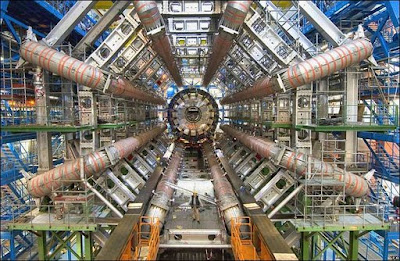 More photos of the LHC at http://www.darkroastedblend.com/2008/03/time-machine-worlds-biggest-particle.html
There is a very engrossing talk by Professor Brian Cox about the LHC. It compresses in 20 minutes a presentation of the best scientific explanation of "what the universe is", and why the LHC is such an important project. I am sure you will enjoy this talk:
http://www.ted.com/index.php/talks/view/id/253
-------------------------------------------------------------
If you need a primer of what is a "Higgs Boson" particle, here is my simplified explanation:
Back in my early school days, I was taught about how all matter is composed of atoms. In fact, the theory of atoms being the fundamental building block of matter was first written by the ancient Greeks back in 400 BC.
However, in the late 19th century, scientists discovered that the atom is not the most fundamental particle (a fundamental particle is a subatomic particle that is not composed of any other subatomic particle). Instead, they found that atoms were composed of electron particles orbiting a nucleus containing protons and a neutrons.
This is probably the level of science that most of us were taught up to in secondary school.
In the mid-20th century, scientists discovered that while electrons are fundamental particles, protons and neutrons were not. Protons and neutrons are composed of an even smaller particle called the quark.
Quarks never exist alone. They are always found in groups of other quarks. A composite particle made of several quarks is known as a "Hadron", which is what the LHC (Large Hadron Collider) is named for.
Thus, the scientists now have 2 fundamental particles: the quark, and the electron.
Unlike the quarks which always exist in groups (you always find quarks in groups of two or three quarks), the electron is always alone (they are said to be solitary particles). However, scientists found that electrons were not the only solitary particle. Besides the electron, scientists found other solitary particles like the muon, the tau, and the neutrino. Scientists categorised these solitary particles as "leptons".
So basically, matter is made of the fundamental particles of quarks and leptons.
(There is actually another group of fundamental particles called "anti-quarks" and "anti-leptons", which are the components of "anti-matter". However, I will not discuss anti-matter in this explanation).
But how do protons and neutrons bind themselves together in the nucleus? Why do magnets attract iron nails? Why do uranium decay, (causing harmful radiation in the process)? Why does the Earth revolve around the Sun?
All these actions are actually forces that are exerted by particles on other particles. Scientists identified 4 kinds of forces, mainly:
More photos of the LHC at http://www.darkroastedblend.com/2008/03/time-machine-worlds-biggest-particle.html
There is a very engrossing talk by Professor Brian Cox about the LHC. It compresses in 20 minutes a presentation of the best scientific explanation of "what the universe is", and why the LHC is such an important project. I am sure you will enjoy this talk:
http://www.ted.com/index.php/talks/view/id/253
-------------------------------------------------------------
If you need a primer of what is a "Higgs Boson" particle, here is my simplified explanation:
Back in my early school days, I was taught about how all matter is composed of atoms. In fact, the theory of atoms being the fundamental building block of matter was first written by the ancient Greeks back in 400 BC.
However, in the late 19th century, scientists discovered that the atom is not the most fundamental particle (a fundamental particle is a subatomic particle that is not composed of any other subatomic particle). Instead, they found that atoms were composed of electron particles orbiting a nucleus containing protons and a neutrons.
This is probably the level of science that most of us were taught up to in secondary school.
In the mid-20th century, scientists discovered that while electrons are fundamental particles, protons and neutrons were not. Protons and neutrons are composed of an even smaller particle called the quark.
Quarks never exist alone. They are always found in groups of other quarks. A composite particle made of several quarks is known as a "Hadron", which is what the LHC (Large Hadron Collider) is named for.
Thus, the scientists now have 2 fundamental particles: the quark, and the electron.
Unlike the quarks which always exist in groups (you always find quarks in groups of two or three quarks), the electron is always alone (they are said to be solitary particles). However, scientists found that electrons were not the only solitary particle. Besides the electron, scientists found other solitary particles like the muon, the tau, and the neutrino. Scientists categorised these solitary particles as "leptons".
So basically, matter is made of the fundamental particles of quarks and leptons.
(There is actually another group of fundamental particles called "anti-quarks" and "anti-leptons", which are the components of "anti-matter". However, I will not discuss anti-matter in this explanation).
But how do protons and neutrons bind themselves together in the nucleus? Why do magnets attract iron nails? Why do uranium decay, (causing harmful radiation in the process)? Why does the Earth revolve around the Sun?
All these actions are actually forces that are exerted by particles on other particles. Scientists identified 4 kinds of forces, mainly:
More photos of the LHC at http://www.darkroastedblend.com/2008/03/time-machine-worlds-biggest-particle.html
There is a very engrossing talk by Professor Brian Cox about the LHC. It compresses in 20 minutes a presentation of the best scientific explanation of "what the universe is", and why the LHC is such an important project. I am sure you will enjoy this talk:
http://www.ted.com/index.php/talks/view/id/253
-------------------------------------------------------------
If you need a primer of what is a "Higgs Boson" particle, here is my simplified explanation:
Back in my early school days, I was taught about how all matter is composed of atoms. In fact, the theory of atoms being the fundamental building block of matter was first written by the ancient Greeks back in 400 BC.
However, in the late 19th century, scientists discovered that the atom is not the most fundamental particle (a fundamental particle is a subatomic particle that is not composed of any other subatomic particle). Instead, they found that atoms were composed of electron particles orbiting a nucleus containing protons and a neutrons.
This is probably the level of science that most of us were taught up to in secondary school.
In the mid-20th century, scientists discovered that while electrons are fundamental particles, protons and neutrons were not. Protons and neutrons are composed of an even smaller particle called the quark.
Quarks never exist alone. They are always found in groups of other quarks. A composite particle made of several quarks is known as a "Hadron", which is what the LHC (Large Hadron Collider) is named for.
Thus, the scientists now have 2 fundamental particles: the quark, and the electron.
Unlike the quarks which always exist in groups (you always find quarks in groups of two or three quarks), the electron is always alone (they are said to be solitary particles). However, scientists found that electrons were not the only solitary particle. Besides the electron, scientists found other solitary particles like the muon, the tau, and the neutrino. Scientists categorised these solitary particles as "leptons".
So basically, matter is made of the fundamental particles of quarks and leptons.
(There is actually another group of fundamental particles called "anti-quarks" and "anti-leptons", which are the components of "anti-matter". However, I will not discuss anti-matter in this explanation).
But how do protons and neutrons bind themselves together in the nucleus? Why do magnets attract iron nails? Why do uranium decay, (causing harmful radiation in the process)? Why does the Earth revolve around the Sun?
All these actions are actually forces that are exerted by particles on other particles. Scientists identified 4 kinds of forces, mainly:
- Strong Nuclear force (the force that binds protons and neutrons in the nucleus of an atom)
- Electro-Magnetism force (the force that allows a magnet to attract iron nails)
- Weak Nuclear force (the force that causes radioactive decay)
- Gravity (the force that stops us from falling into space)
- Gluon : Strong Nuclear force
- Photon : Electro-Magnetism force
- W+, W-, Z : Particles for the Weak Nuclear force
- Graviton : Gravity
Wednesday, 5 December 2007
BBC News video: Chimps beat humans in memory test
This is an eye-popping news feature from BBC News. This video is definitely a MUST watch!
http://news.bbc.co.uk/player/nol/newsid_7120000/newsid_7126100/7126174.stm?bw=bb&mp=wm
The chimpanzees are absolutely amazing. Chimpanzees are of course, the closest animal relative to human beings on the evolutionary tree. I know chimps are extremely intelligent creatures as evident from many a Hollywood movie and from science documentaries. Chimps know how to use tools, can be taught Sign Language, and are known to exhibit many human characteristics (like altruism).
However, this is the first time we know that chimps actually have an EXCELLENT (photographic?) memory. This memory faculty far surpasses our own.
I have always thought humans are superior to all other animals when it comes to brain (cognitive) functions. This has now been proven completely wrong! Watching the chimps' stunning performances is truly humbling :-)
The accompanying text article is here:
http://news.bbc.co.uk/2/hi/science/nature/7124156.stm
Friday, 23 November 2007
Science Lectures - "Growing Up In The Universe"
Professor Richard Dawkins is the famous evolutionary biologist and ethologist who wrote the book "The Selfish Gene" and introduced the word "meme" into everyday English. Richard Dawkins is also the current holder of the "Charles Simonyi Chair for the Public Understanding of Science" at the University of Oxford.
In 1991, Richard Dawkins gave a series of 5 one-hour lectures on Science which was telecast on BBC television. These lectures were aimed at children and young adults. Recently, all 5 lectures were made available on the internet for free viewing online by Richard Dawkins' foundation (prior to the free release, you would have to buy the DVD to view them).
If you have young children who are interested in science (maybe they want work in the fast growing Biomedical/ Biotechnology industries that Singapore is investing huge amounts of money in currently when they grow up), they might find these science lectures interesting. I watched them last night, and they were so engrossing I had to watch all 5 of them at one sitting. They are exceptionally educational and absorbing.
This is a short segment from one of the lectures explaining how our human eyes have evolved:
http://www.youtube.com/watch?v=rUOpaFVgKPw
If your children find this segment to be interesting, they may want to watch the entire 5 lectures. As for myself, I have never had science lessons when I was young presented in such a fascinating manner. Indeed, I found this series to be very illuminating as I had always marvelled at the incredible workings of the human eye. In another lecture, the even more complex brain and its workings are described.
All 5 lectures can be watched from the Richard Dawkins Foundation for Reason and Science website:
 http://richarddawkinsfoundation.org/foundation,growingupintheuniverse
http://richarddawkinsfoundation.org/foundation,growingupintheuniverse
Subscribe to:
Posts (Atom)